Technical detail
Transglutaminase for Clean-Label and Yield Projects
Clean-label reformulation and yield improvement often meet at the same point: protein structure. When a product needs fewer binders, less purge, better slice integrity, or a more controlled bite, the answer is rarely a single ingredient swap. It is a protein-system design project.
Transglutaminase, also known as protein-glutamine gamma-glutamyltransferase, is used to strengthen compatible protein networks by creating stable cross-links between protein chains. For B2B teams, the commercial value is practical: improved binding strength, higher retained moisture, cleaner cuts, more resilient gels, and more formulation room when starches, gums, phosphates, or other functional additives are being reduced.
Wholesale and bulk transglutaminase for food manufacturers, ingredient blenders, distributors and resellers. Every order is quoted individually. Request a quote with your product or application, the quantity you need and the destination country.
Where transglutaminase fits in a clean-label strategy
Clean-label does not mean structurally simple. It means every ingredient has to earn its place.
Transglutaminase can support cleaner formulations by helping proteins perform more of the structural work themselves. Depending on the system, this may allow R&D teams to reduce reliance on texture modifiers, simplify stabilizer systems, or maintain product quality after removing ingredients that consumers or retailers are watching more closely.
Typical clean-label goals include:
- Reducing auxiliary binders while maintaining bite, cohesion, or sliceability
- Improving water retention without making the texture pasty or over-built
- Supporting simpler declarations where the enzyme is compatible with the intended label position and regional rules
- Improving consistency across variable protein raw materials
- Protecting eating quality during chilling, slicing, packing, distribution, and reheating
The strongest projects start with a defined product outcome, not a generic enzyme trial.
Yield improvement is a structure problem
Yield loss often shows up as purge, cook loss, trimming loss, broken portions, weak gels, or poor slice recovery. In many protein systems, those issues are connected to incomplete network formation.
Transglutaminase can help create a tighter internal architecture so moisture, fat, and particulates are held more effectively during processing and handling. The result can be improved process economics without making the finished product feel artificially firm.
Commercial teams usually evaluate value through:

- Cook yield or thermal process retention
- Reduced drip or purge in chilled storage
- Improved portion integrity during forming, slicing, or packing
- Lower breakage and rework
- More consistent texture across raw-material variation
- Potential reduction of non-protein binders or stabilizers
The business case should include ingredient cost, process time, rework reduction, packaging performance, and sensory acceptance — not just enzyme inclusion cost.
Application areas
Meat and poultry systems
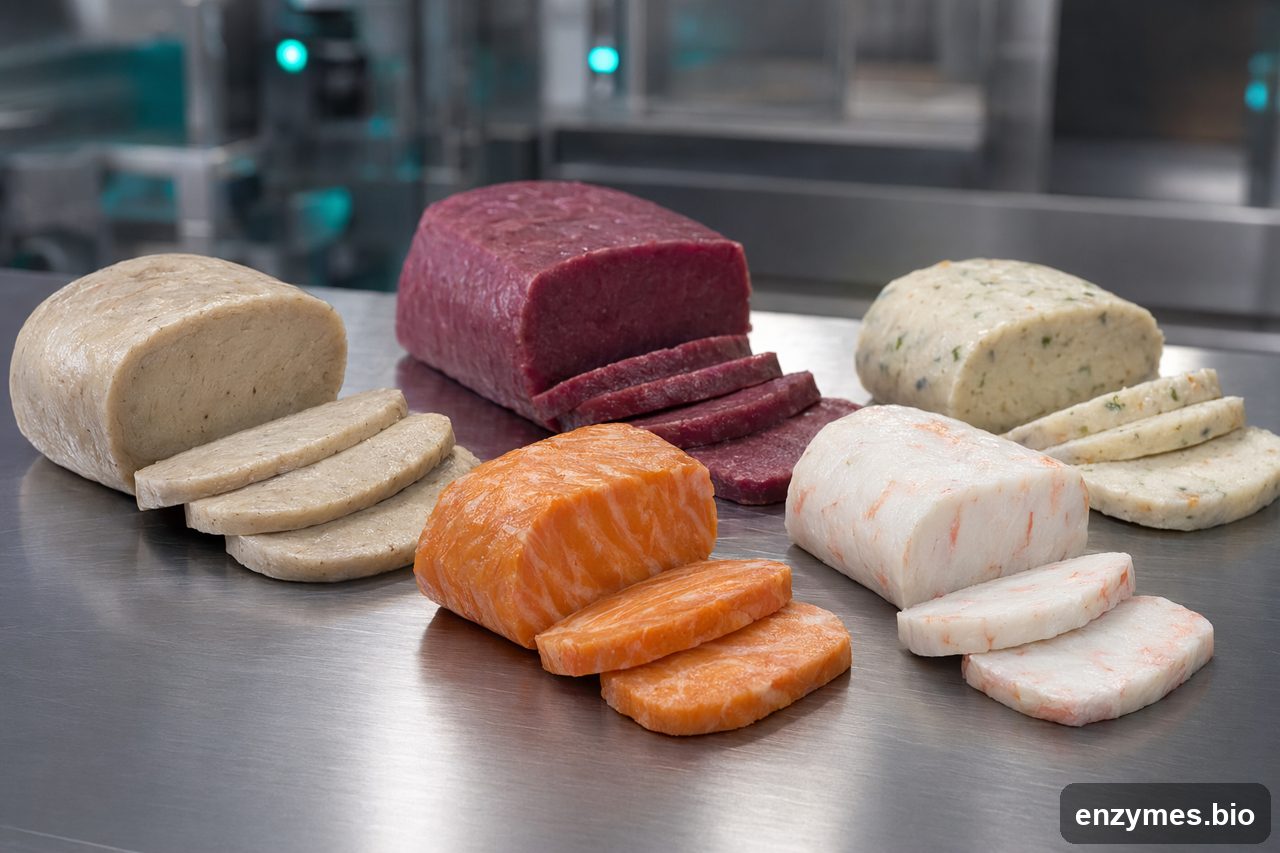
In comminuted, formed, restructured, or value-added meat systems, transglutaminase can support binding strength, slice integrity, bite definition, and yield retention. It is often assessed where processors need more reliable cohesion without overworking the formulation.
Key evaluation points include protein availability, salt level, moisture phase, particle size, mixing energy, hold conditions, and the final heat process.
Seafood and surimi-style products
Seafood systems can be sensitive to texture damage, purge, and weak gel formation. Transglutaminase may help improve elastic bite, gel strength, portion stability, and freeze-thaw resilience, depending on the protein base and process design.
Trials should pay close attention to raw-material variability, water management, temperature control, and final product handling.
Dairy and fermented formats
In dairy protein systems, transglutaminase can support firmer gels, improved viscosity, reduced syneresis, and better texture retention. It is commonly evaluated in applications where the product needs to feel richer or more stable without excessive stabilizer load.
Important variables include milk protein composition, solids level, heat history, culture system, pH path, and shear after structure formation.
Plant-protein and hybrid products
Plant proteins vary widely in solubility, functionality, flavor load, and process tolerance. Transglutaminase can give formulators an additional structural lever for improving binding, bite, juiciness, and cut quality in plant-based or hybrid formats.
The best candidates are systems with enough accessible protein functionality and a process window that gives the enzyme time to build structure before final stabilization.
How to evaluate transglutaminase without wasting trial cycles
A productive evaluation should be built around the actual manufacturing constraint. Before screening, define the target texture, the required label position, the cost boundary, and the process steps that cannot change.
1. Map the protein system
Identify the primary proteins, supporting proteins, water phase, fat phase, salt level, pH range, and any competing ingredients. Transglutaminase performs differently depending on protein accessibility and how the matrix is hydrated.
2. Define the process window
Time, temperature, mixing, rest, forming, fermentation, chilling, and heat treatment all influence the final structure. A good enzyme choice must fit the process you can actually run at scale.
3. Screen for texture and yield together
Do not optimize yield at the expense of eating quality. Track firmness, elasticity, bite, slice quality, purge, cook retention, and sensory response in the same trial plan.
4. Watch for over-structuring
More binding is not always better. Excessive network formation can create rubbery bite, reduced juiciness, poor spreadability, or brittle gels. The target is controlled architecture, not maximum hardness.
5. Confirm scale-up behavior
Bench success needs to survive mixing energy, line speed, fill weight, pack format, thermal profile, and distribution abuse. Procurement should also confirm grade availability, documentation, lead time, and batch consistency before locking the specification.
What to specify when requesting pricing
To recommend the right transglutaminase grade, we typically need application context rather than confidential formulas. Useful information includes:
- Product category and finished format
- Protein source and approximate protein level
- Current texture or yield problem
- Ingredients being reduced or removed
- Process overview: mix, hold, form, heat, chill, pack
- Target label requirements and market region
- Trial scale and expected commercial volume
- Required documentation or procurement constraints
We do not need full recipes to begin a technical quotation conversation.
Procurement considerations
For sourcing teams, transglutaminase is not a commodity decision if the project depends on performance. Review grade fit, documentation package, allergen and carrier profile, country-of-origin requirements, shelf-life expectations, packaging size, batch consistency, and supply reliability.
A lower input cost can become expensive if it creates inconsistent binding, longer process holds, poor sensory results, or plant-floor rework. The right commercial grade is the one that meets the formulation target and protects line economics.
Common project goals
Transglutaminase is often evaluated when teams need to:
- Improve yield without making the product dense
- Replace or reduce selected binders, gums, starches, or phosphates where feasible
- Strengthen formed or sliced products
- Reduce purge in chilled or cooked formats
- Improve gel strength in dairy, seafood, or plant-protein systems
- Create better bite in hybrid protein systems
- Stabilize texture across raw-material variation
- Support premium positioning through cleaner texture and better cut quality
Request a quote or get pricing
Tell us what you are making and what needs to improve. Transglutaminase Enzyme Solutions can help you identify the right transglutaminase grade for clean-label reformulation, yield improvement, or protein-structure development.
Ready for a quote? Use the inquiry form at the foot of this page. Tell us the application, the quantity per order or per year and the delivery country. Price, pack size and lead time are quoted per order.